Running a small or medium-sized enterprise (SME) in 2025 means juggling a million tasks while keeping customers happy. Customer service is your frontline—it’s where trust is built, sales are saved, and loyalty is earned. But with limited staff and budgets, how do you deliver fast, personalized support 24/7? Enter AI-powered customer service tools, like chatbots, that can handle queries, resolve issues, and even upsell—all driven by the prompts you write. A well-crafted AI prompt is like giving your chatbot a script to shine, while a bad one can make it sound robotic or useless.
This article walks you through how to write AI prompts for customer service that make your SME stand out. We’ll cover why prompts matter, best practices for crafting them. By the end, you’ll have a toolkit of prompts to boost efficiency, delight customers, and drive revenue for your eCommerce, service, or B2B business. Let’s dive in.
1. Why AI Prompts Matter for SME Customer Service
AI prompts are the instructions you give your chatbot to handle customer interactions. Think of them as the brain behind the bot—guiding it to respond helpfully, not like a cold machine. For SMEs, this is a game-changer: AI is not only reducing the time agents spend per customer but also improving how customers feel about the help they receive. Speed + satisfaction = better support outcomes (Source: Delight.fit – AI in Customer Care). Why? Because good prompts make chats feel human, solve problems fast, and free your team for high-value tasks.
Bad prompts, though, can derail your efforts. A vague instruction like “Answer questions” might lead to generic replies that frustrate customers. And for SMEs, where every customer counts, that can mean lost revenue and damaged trust.
Good prompts, on the other hand, can:
- Save Time: Handle routine queries without needing a human agent.
- Boost Sales: Suggest relevant add-ons or upgrades that increase order value.
- Build Loyalty: Deliver fast, personalized responses that keep customers coming back.
The catch? Writing prompts that actually deliver results takes strategy. Let’s break down how to do it right.
2. Best Practices for Writing AI Customer Service Prompts
Crafting effective AI prompts is part art, part science. Your goal is to make the chatbot sound natural, solve problems, and align with your brand. Here are six best practices to nail it, tailored for SMEs:
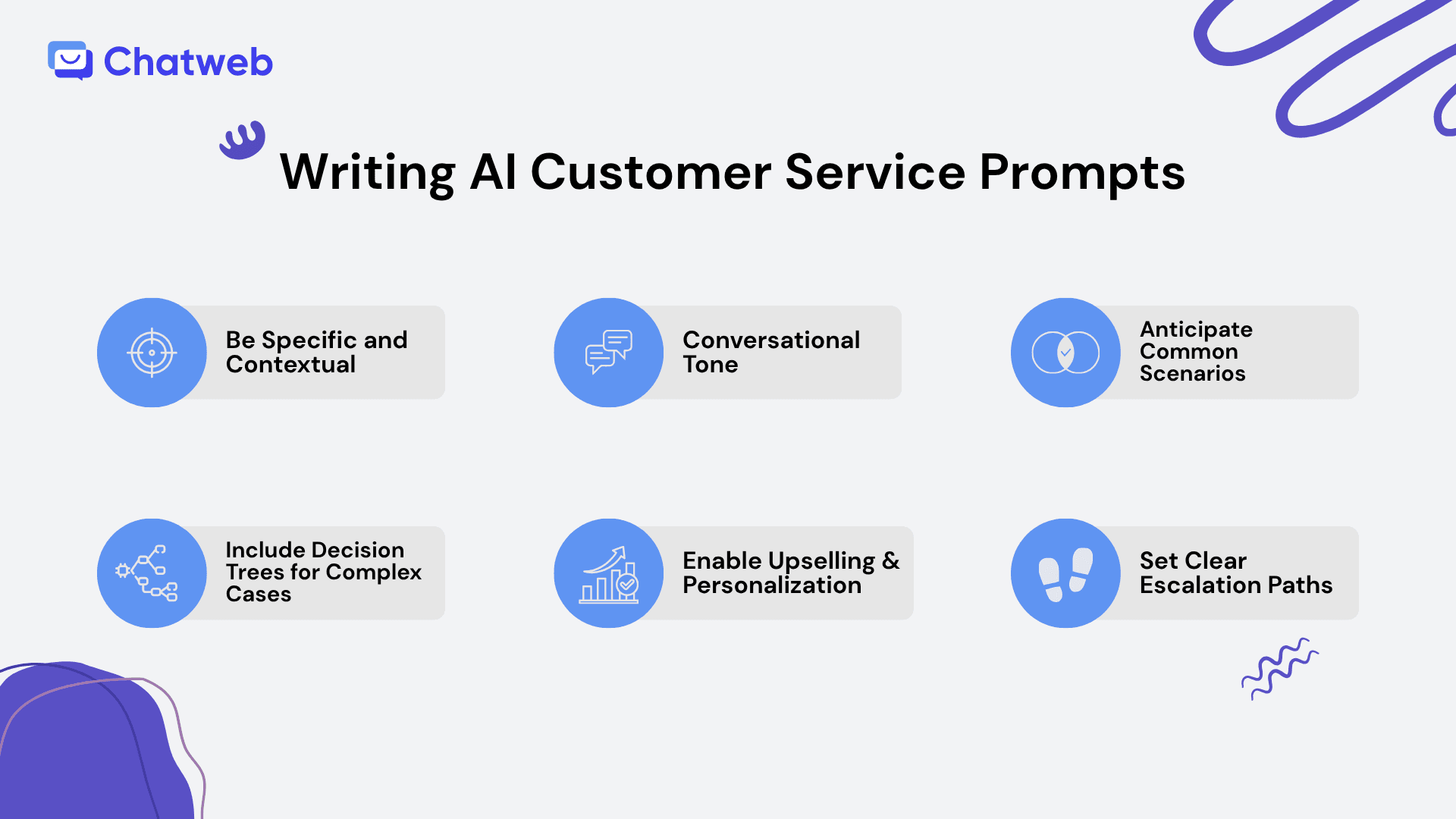
2.1. Be Specific and Contextual
Vague prompts like “Help the customer” lead to bland, unhelpful replies. Instead, guide the AI with clear instructions and context—such as the customer’s issue, the page they’re on, or your brand’s tone.
Why It Matters:
Specific prompts reduce confusion and help the bot respond accurately.
How to Do It:
Define the scenario and the desired action like:
“If the customer asks about shipping on the checkout page, offer a free shipping code if the cart exceeds $50.”
2.2. Use a Conversational Tone
Customers dislike robotic replies. Your prompt should guide the AI to reflect your brand’s voice—whether that’s friendly, professional, or playful.
Why It Matters:
A human-like tone makes conversations more engaging and builds trust.
How to Do It:
Include tone instructions like:
“Respond in a friendly and upbeat tone.”
Avoid jargon unless it suits your audience.
2.3. Anticipate Common Scenarios
SMEs often face repetitive questions like “Where’s my order?” or “What’s your return policy?” Prompts should be ready to handle these efficiently.
Why It Matters:
Covering frequent issues helps bots manage most queries, freeing up your team.
How to Do It:
List your top 5–10 customer questions from past chats or support tickets. Write clear prompts for each, including when to escalate.
2.4. Include Decision Trees for Complex Cases
Some customer issues require logic and branching paths—like troubleshooting or refund requests. Prompts should include if-then rules to guide the AI.
Why It Matters:
Structured prompts help the bot handle nuanced situations without confusion.
How to Do It:
Map out the logic.
Example:
“If the order is older than 30 days, offer store credit. Otherwise, process a refund.”
Include escalation instructions for edge cases.
2.5. Enable Upselling and Personalization
Chatbots can do more than answer questions—they can sell. Prompts should use customer data to suggest relevant products or upgrades.
Why It Matters:
Personalized suggestions increase customer interest and order value.
How to Do It:
Instruct the AI to analyze browsing history or cart contents.
Example:
“Based on the customer’s cart, recommend a bundle that includes complementary items.”
2.6. Set Clear Escalation Paths
Bots can’t solve everything. Prompts should tell the AI when to hand off to a human agent—quickly and smoothly.
Why It Matters:
Fast handoffs prevent frustration and preserve customer trust.
How to Do It:
Add rules like:
“If the customer uses words like ‘urgent’ or repeats the same question three times, transfer to a live agent and include chat history.”
3. AI Prompt Examples for SME Customer Service Scenarios
Below are detailed prompt examples for five common SME customer service scenarios, designed to work with platforms like Chatweb. Each includes the scenario, prompt, and why it works. Feel free to tweak these for your business.
3.1. Handling Shipping and Delivery Queries
Scenario: Customer on the checkout page asks, “When will my order arrive?” or “How much is shipping?”
Prompt:
“You are a friendly, helpful chatbot for an e-commerce SME. When a customer asks about shipping or delivery on the checkout page, check their cart total.
– If the cart is over $50, respond: ‘Great news! Your order qualifies for free standard shipping, arriving in 3–5 business days. Want expedited 2-day shipping for $5?’
– If the cart is under $50, say: ‘Standard shipping is $5, arriving in 3–5 business days. Add $10 more to your cart for free shipping! Need help picking items?’
– If they ask specifically about delivery time, provide estimated dates for both standard and expedited options.
Use a warm, encouraging tone. If the question is unclear or repeated, escalate to a human agent with the chat history.”
Why It Works:
Clear logic based on cart value, friendly tone, and subtle upselling make this prompt both helpful and commercially effective.
3.2. Processing Refund or Return Requests
Scenario: Customer asks, “Can I return this?” or “I want a refund.”
Prompt:
“You are a professional, empathetic chatbot for an SME. When a customer asks about refunds or returns, check their order status.
– If the order is within 30 days, respond: ‘No worries! You can return your item within 30 days for a full refund. Want me to start the process or send you the return label link?’
– If the order is over 30 days, say: ‘Since your order is past 30 days, we can offer store credit. Would you like to proceed, or have questions about eligible items?’
Use a calm, supportive tone. If the customer seems upset or asks complex questions, escalate to an agent with full context.”
Why It Works:
Combines decision logic with empathy and escalation to ensure smooth handling of sensitive issues.
3.3. Answering Product FAQs
Scenario: Customer asks, “Does this fit size M?” or “Is this product vegan?”
Prompt:
“You are a friendly, knowledgeable chatbot for an SME. When a customer asks about product details (e.g., size, materials, features), access the product database and respond with specifics.
– For sizing: ‘The size M fits a 32–34 inch waist, true to size. Want to check your measurements or see similar styles?’
– For ingredients or features: ‘This product is 100% vegan and cruelty-free. Interested in our vegan bundle for a special discount?’
Use an upbeat, helpful tone. If the question isn’t in the database or is repeated, escalate to a human with chat details.”
Why It Works:
Delivers accurate product info, encourages upsells, and ensures fallback support when needed.
3.4. Upselling During Checkout
Scenario: Customer is on the checkout page with items in their cart.
Prompt:
“You are an engaging, helpful chatbot for an e-commerce SME. When a customer reaches checkout, analyze their cart contents and suggest a relevant upsell.
– If they have a shirt: ‘Nice choice! Pair that shirt with our matching tie for just $10 more—want to add it now?’
– If the cart exceeds $100: ‘You’re eligible for a bundle discount if you add one more item. Need recommendations?’
Use a friendly, non-pushy tone. If they decline or ask unrelated questions, respond helpfully or escalate to an agent.”
Why It Works:
Uses cart data to personalize upsells while maintaining a light, customer-friendly tone.
3.5. Handling Complaints or Urgent Issues
Scenario: Customer says, “My order is late!” or “This is urgent!”
Prompt:
“You are a calm, empathetic chatbot for an SME. When a customer mentions ‘late,’ ‘urgent,’ or seems upset (e.g., uses all caps or exclamation points), respond:
‘I’m so sorry for the trouble! Let’s fix this—can you share your order number so I can check the status?’
– If tracking data is available: ‘Your order is due tomorrow—want me to confirm with the carrier?’
– If no data or the customer remains upset, escalate immediately to a human agent with the full chat log, saying: ‘I’m connecting you to our team for quick help.’
Use a caring, professional tone.”
Why It Works:
Prioritizes empathy and fast resolution, which are critical in high-stress customer moments.
4. Tips for Implementing and Optimizing AI Prompts
Writing prompts is step one; making them work long-term is the goal. Here’s how SMEs can implement and refine them:
- Start Small: Test prompts on one scenario (e.g., shipping queries) for a month. Monitor response quality and customer feedback.
- Use Analytics: Check chatbot metrics like resolution rate (aim for 70%) and escalation frequency. Tweak prompts if customers repeat questions.
- Train Your Team: Ensure agents know when bots escalate—train them to pick up seamlessly with chat history.
- A/B Test Prompts: Try two versions (e.g., formal vs. casual tone) to see which drives more sales or satisfaction.
- Update Regularly: Review transcripts monthly to catch new FAQs or pain points. Add prompts for emerging trends (e.g., “Is this eco-friendly?”).
- Integrate with CRM: Sync chats with tools like ActiveCampaign to track leads and personalize follow-ups, boosting retention.
Avoid: Overly complex prompts (AI might misinterpret) or no human backup (~25% of cases need it). Keep prompts clear and customer-focused.
Wrapping Up
Try Chatweb—an AI-powered platform designed for SMEs to deliver fast, personalized support with easy-to-set prompts. Start your free trial today and watch your customers—and revenue—smile!
📩 Have questions or want to explore how Chatweb can help your business? Contact us at hello@chatweb.io.

![[PayPal x Chatweb] Chatweb is now an official PayPal Payment Partner!](https://assets-content.aifusionlab.io/image_c1163cbd0d.png)